
How to Close an Inactive Company Legally: Step-by-Step ROC Guide
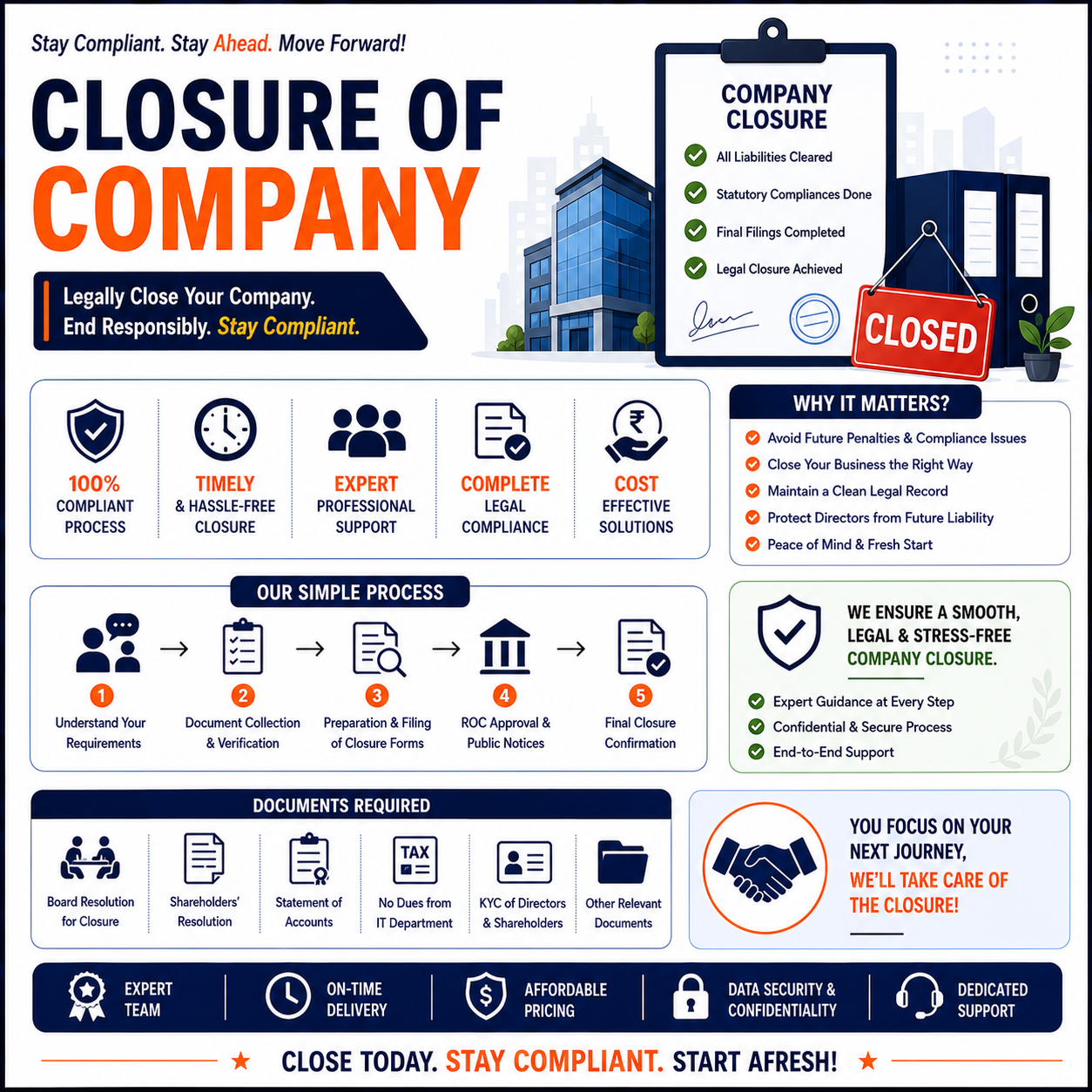
Closure of Company Wind Up
Closing a business is a major legal event that requires a systematic approach to settle all debts and distribute remaining assets Whether you are opting for a voluntary company wind up navigating a formal LLP closure or managing the complexities of a company wind up, you need an expert to manage the technicalities. We understand that this transition is complex but we ensure every legal formality is handled with absolute precision to protect your reputation and keep you clear of future liabilities Managing the legal existence of your entity involves clearing dues with creditors and finalizing asset distributions before your name is removed from the official registerIf you need assistance with an LLP closure or a company wind up, our team manages the entire process for you We take charge of the documentation so you can close this chapter without the usual administrative stress Our team specializes in ensuring that all statutory compliance requirements are met during the exit phase, including the specialized procedures required for an LLP closure and any company wind up scenario. Our digital-first approach ensures that everything is filed correctly and on time We take pride in helping you navigate these final steps smoothly, preventing any legal gaps By choosing us, you gain a partner who prioritizes your peace of mind during this transition, whether you are initiating a company wind up or a seamless LLP closure. We remain committed to supporting your business journey from inception to a successful conclusion Whether you are scaling operations or preparing for a company wind up, we ensure that your LLP closure processes are managed with complete regulatory compliance and professional oversight.
Conclusion of a business organization is the procedure whereby the name of the company gets struck off the list of companies registered under the Registration of Companies. This is done through the procedure stipulated in the Companies Act 2013.
A company may consider closure when:
- The business is no longer operational.
- The promoters do not wish to continue the business.
- The company has no assets or liabilities.
- The company has remained inactive for a long period.
A company can be closed through:
Voluntary Strike Off under the Companies Act, 2013.
Winding Up through the Tribunal, where applicable.
The Insolvency and Bankruptcy Code provides for the liquidation of companies.The Insolvency and Bankruptcy Code is a law that allows for the liquidation of companies.
The commonly required documents include:
Board Resolution.
Special Resolution or shareholder consent.
Indemnity Bond.
Affidavit by Directors.
Statement of Accounts certified by a Chartered Accountant.
PAN Card of the Company.
Certificate of Incorporation.
Copy of the latest financial statements.
Identity proof of directors.
The timeline varies depending on the company’s compliance status and ROC processing. Generally, the process takes 60 to 120 days, subject to verification and approval.
Yes, in most cases a company can only be closed with the approval of the shareholders Before initiating the closure process the company must pass a Special Resolution or obtain the consent of the required majority of shareholders as prescribed under the Companies Act 2013The resolution gives the directors permission to close the company.
The approval process typically involves:
A General Meeting or obtaining the necessary shareholder consent by passing a Special Resolution.
- Documenting the decision in the minutes of the meeting.
- Submitting the required forms and resolutions to the Registrar of Companies
- Completing all statutory compliances or outstanding liabilities or taxes and regulatory requirements prior to closure
Closing an inactive company is beneficial:
Avoid annual compliance expenses.
Save on annual compliance costs.
Never pay for failure to file.
Keep directors safe from future compliance problems.
Yes. It is possible to wind up a private limited company voluntarily if it fulfill certain conditions.
Yes. A dormant company that meets the prescribed legal conditions and has no liabilities can apply for closure through the appropriate procedure.